LIQUID PENETRANT INSPECTION (LPI)
Liquid Penetrant Inspection (LPI)
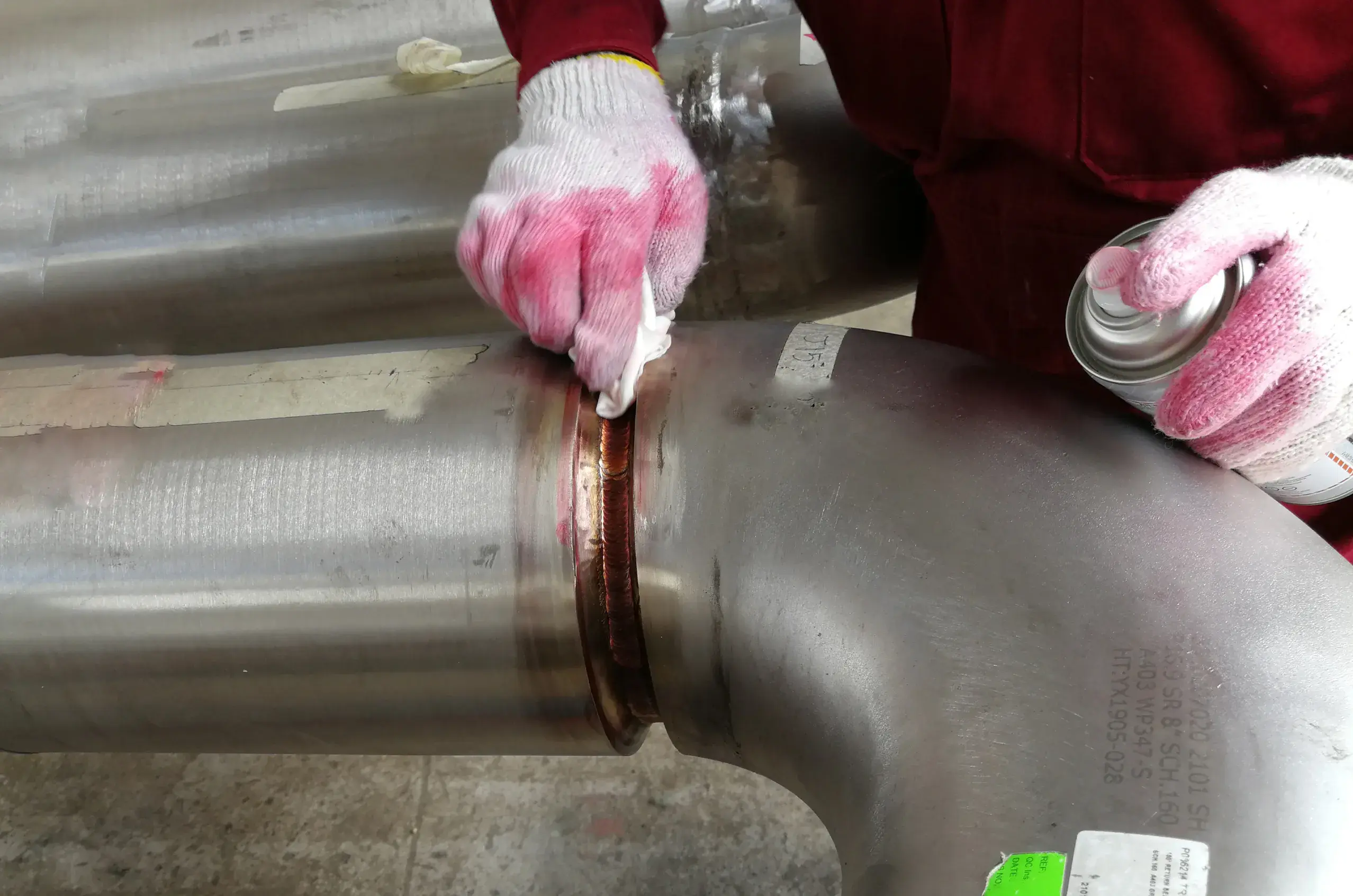
Liquid penetrant inspection for detecting surface-breaking defects in ferrous and non-ferrous materials. Capable of finding extremely fine flaws including hairline cracks and porosity.
Liquid Penetrant Inspection (LPI) detects surface-breaking defects in non-ferrous and ferrous materials. It is particularly suited for identifying hairline cracks, surface porosity, leaks in new products, and fatigue cracks on in-service components.
Hairline Crack Detection
LPI is highly sensitive to fine surface-breaking flaws that may not be visible to the naked eye. The method reliably detects hairline cracks, stress corrosion cracking, and fatigue cracks on in-service components.
Surface Porosity Identification
We identify surface porosity, pinholes, and leaks in new products and fabricated components. The penetrant is drawn into surface-breaking discontinuities by capillary action and revealed by a developer, providing clear indications for evaluation.
Ferrous & Non-Ferrous Materials
LPI works on castings, forgings, and welding surfaces across magnetic and non-magnetic metals, some plastics, and glass, making it versatile for applications where magnetic particle inspection cannot be used.
Colour Contrast & Fluorescent
We offer both visible colour contrast and fluorescent penetrant techniques. For high-sensitivity applications on intricate parts, fluorescent penetrant with UV blacklight provides enhanced detection in controlled lighting conditions.
Castings, Forgings & Welds
We perform LPI on castings, forgings, and weld surfaces to identify surface-breaking discontinuities as part of fabrication quality control, in-service inspection programmes, and pre-service acceptance testing.
Related Services
NDT & Weld Coordination
NDT and weld coordination services including inspection planning, technique selection, procedure development, and reporting. Ensuring the right method at the right time.
Visual Inspection (VT)
Visual inspection services for welds, machined components, castings, and forgings. Adaptable for site and workshop environments with immediate detection of surface defects.
Magnetic Particle Inspection (MPI)
Magnetic particle inspection for checking the surface integrity of ferromagnetic materials. Detects surface and subsurface defects in welds, castings, and forgings.